Deutsch 30
A German course for Indonesian learners, organised into one thirty-day sprint for each CEFR level. Grammar starts with patterns learners can see and use.
Challenge
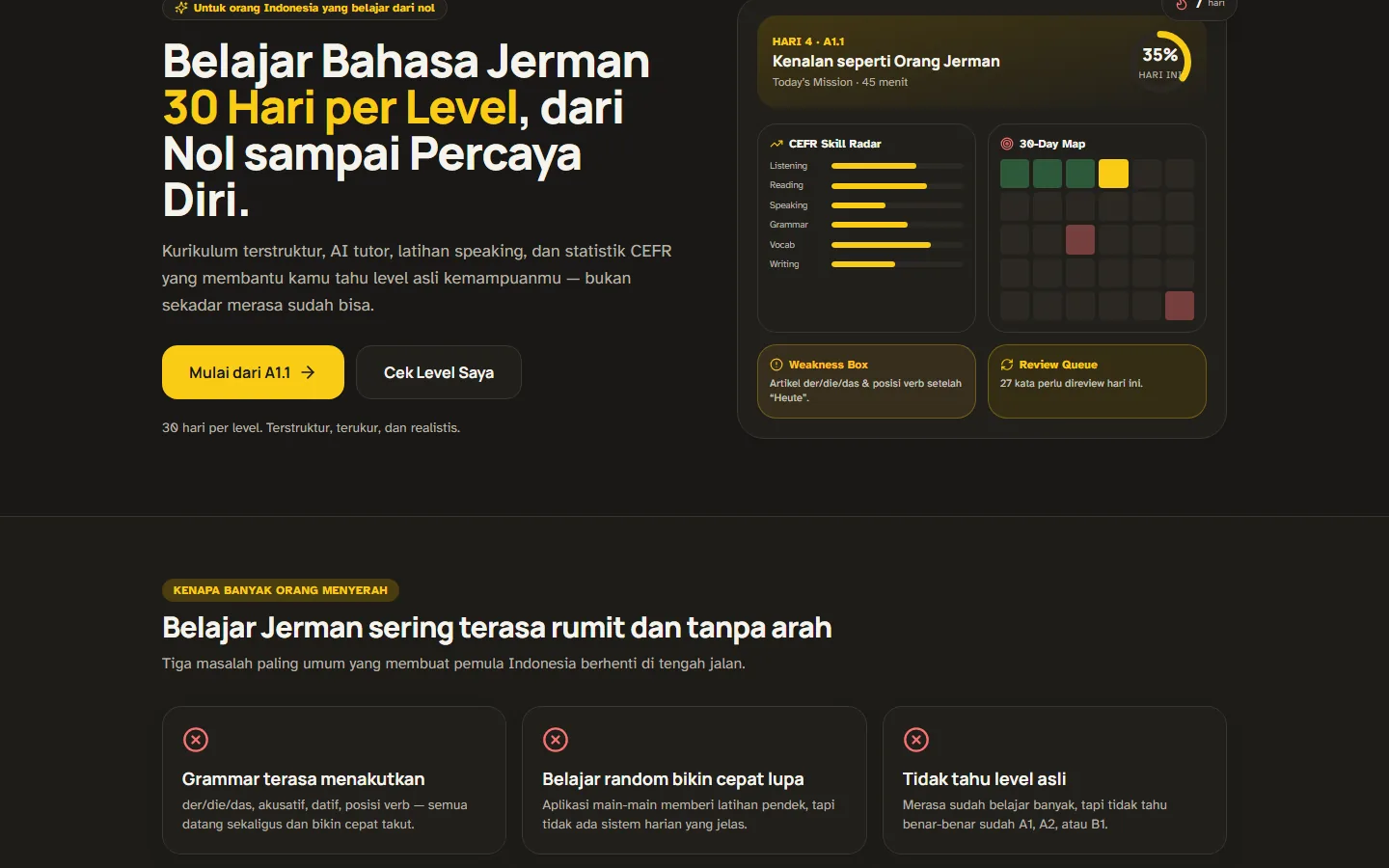
Starting German is easy. Staying consistent without a clear path is much harder.
The product names three problems it is built against, and they are the ones that actually end self-study. Grammar is intimidating, arriving as a wall of rules before any of it is useful. Studying without structure means studying at random, and random study is forgotten quickly. And with no reliable level check, a learner cannot tell whether they are progressing or circling.
The consequence is not that people fail. It is that they stop, usually inside the first month, with no evidence either way about how they were doing.
- Falls shortA grammar textbookFront-loads the rules. The learner meets the hardest, least useful material first and stops before any of it pays off.
- Falls shortA streak-based language appIt rewards returning tomorrow, but a long streak does not always show what the learner can say.
- Falls shortStudying from scattered free materialNamed on the site as the problem: random study, quickly forgotten, with no way to tell your real level.
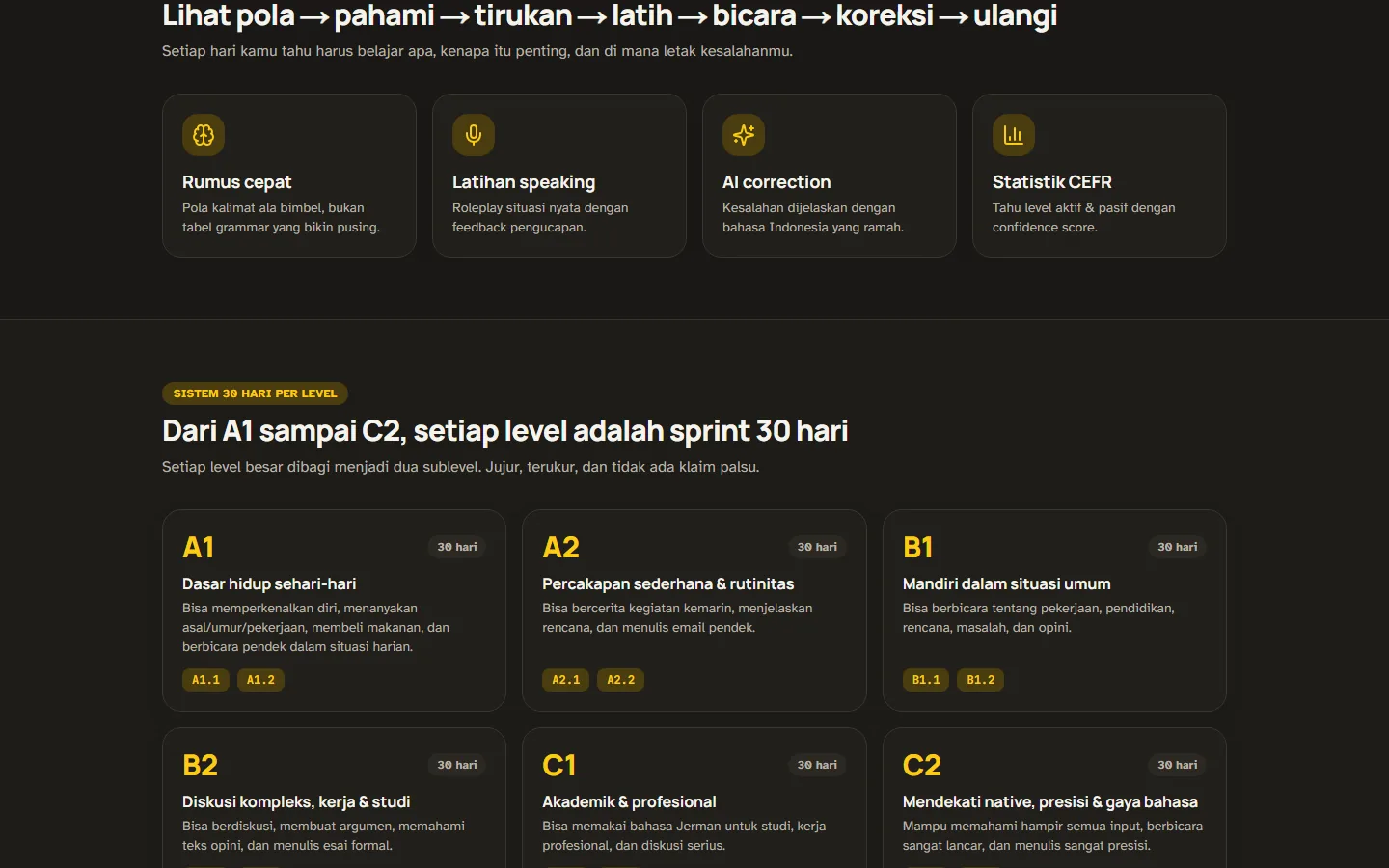
Lihat pola → pahami → tirukan → latih → bicara → koreksi → ulangi
Research & framing
Structure, flows & trade-offs
Each CEFR level follows the same thirty-day sprint.
The whole curriculum rests on a single repeating unit. Each CEFR level is a thirty-day sprint with a stated outcome: A1 for everyday basics, A2 for simple conversation and routine, B1 for handling ordinary situations independently, on up to C2. Fixing the unit means the next milestone is always a known distance away.
Inside a sprint the method is a loop, not a syllabus: see the pattern, understand it, imitate it, drill it, speak it, get corrected, repeat. Grammar shows up as a pattern to recognise rather than a rule to recite.
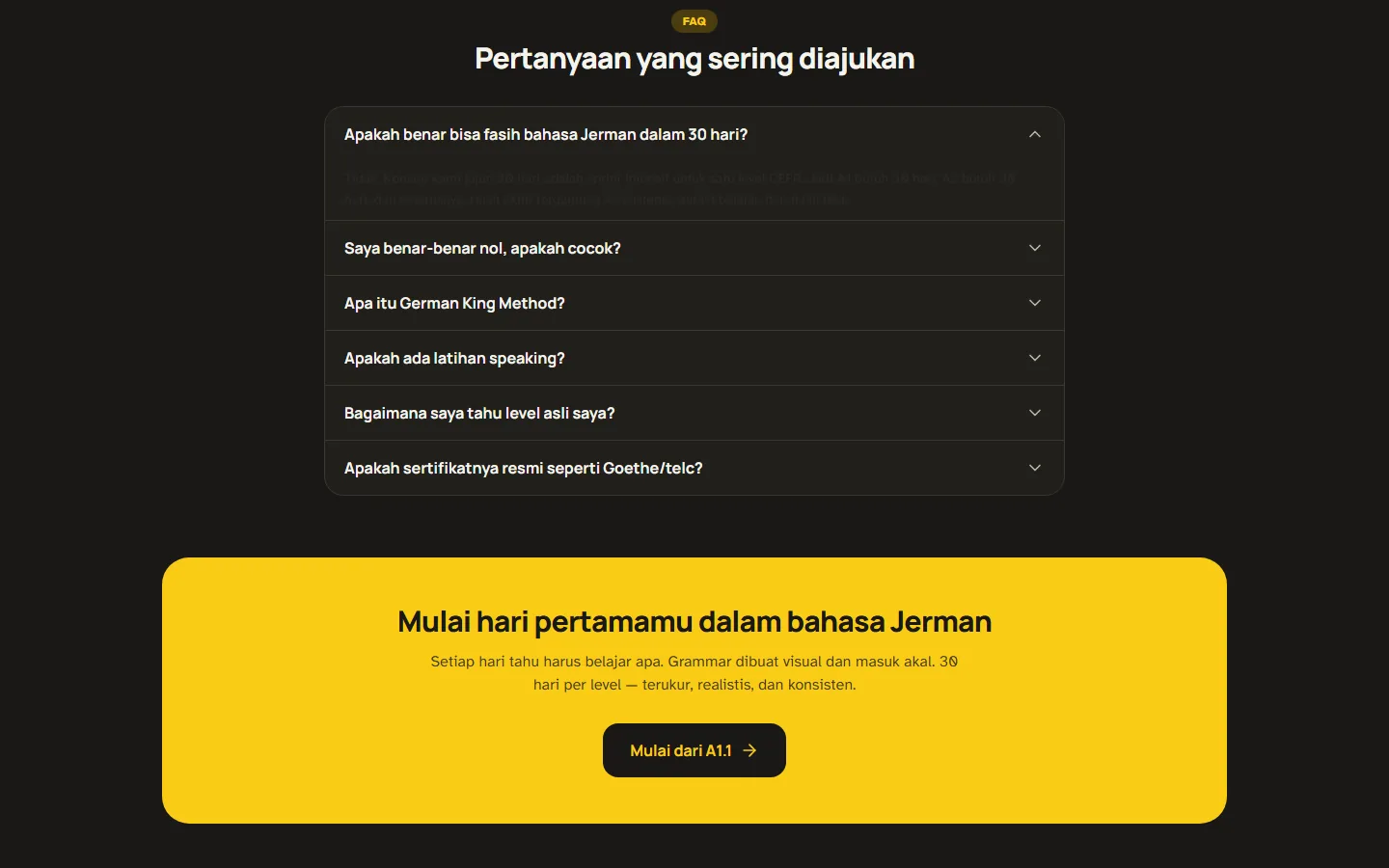
The public site is arranged to match — method, roadmap, statistics, FAQ — so a visitor can check how it is taught, see the whole ladder, and find their real level before committing to day one.
- ChosenOne CEFR level per thirty-day sprintA fixed unit means the next milestone is always a known distance away, which is what an open-ended curriculum can never offer.
- ChosenGrammar taught as pattern, not ruleNamed tools such as Sentence Lego and Verb Position Radar give structure a handle. The rule arrives after the pattern is recognisable.
- ChosenA level check before day oneSix onboarding questions. Without a real starting level the learner cannot tell progress from circling, which is the third problem the page names.
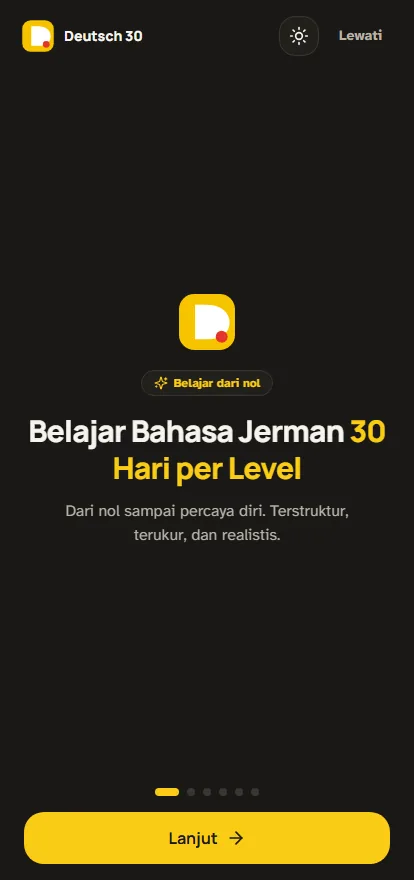
Before any of it starts, onboarding asks six short questions, beginning with a name and a progress marker reading step one of six. Stating the length of a form at its start is a small detail that helps people decide whether to finish it. This one exists to place the learner on the CEFR ladder, which is the third of the three problems the landing page names.
Solution
Four supports around the loop, each aimed at one of the three failure modes.
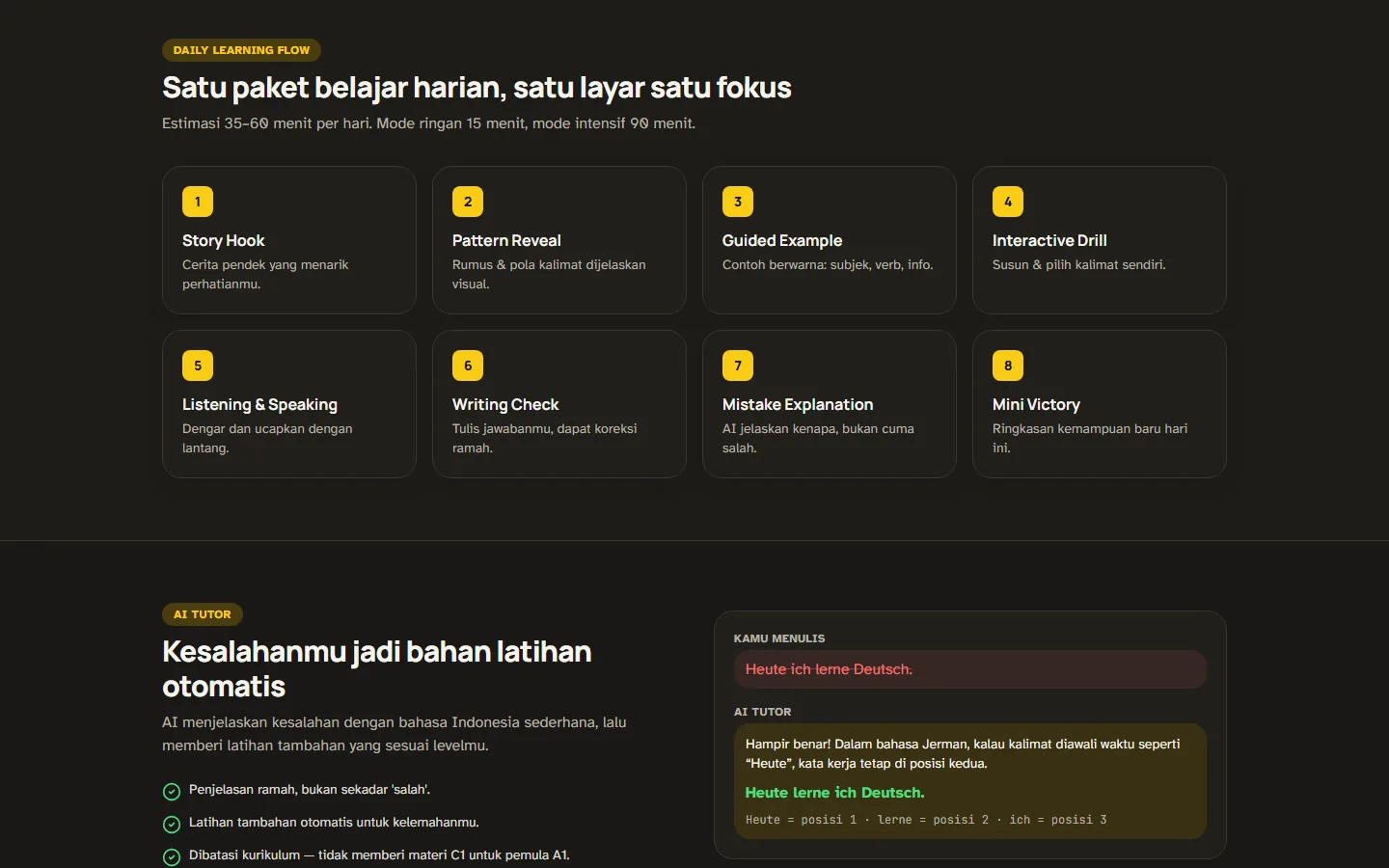
Fast formulas. Grammar compressed into short reusable patterns, with named tools such as Sentence Lego and Verb Position Radar giving structure something to hold on to — the answer to grammar feeling like a wall.
Speaking practice inside the daily loop. Not deferred until the learner feels ready, which is the point most self-study never reaches.
AI correction. Feedback on what the learner produces, which is what turns imitation into accuracy instead of repetition.
CEFR statistics. Level tracking against the standard scale, so "what level am I really" has a visible answer rather than a guessed one.
Above all of it, the roadmap: every level from A1 to C2 laid out with what it unlocks, so a thirty-day commitment is made with the whole path in view.
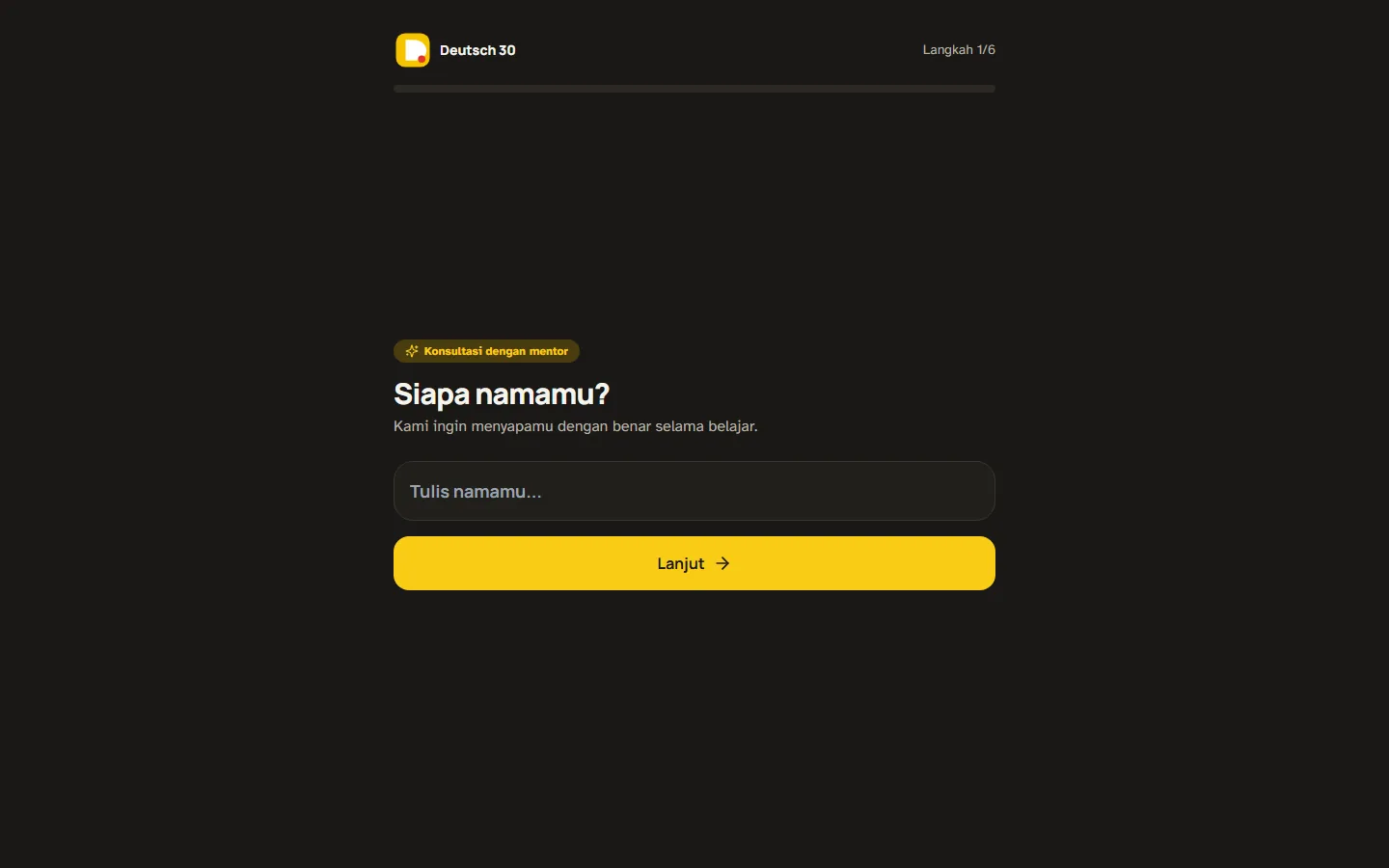
A day is eight steps, and they are named: story hook, pattern reveal, guided example, interactive drill, listening and speaking, writing check, mistake explanation, mini victory. Publishing the shape of a session is what makes a thirty-day commitment legible — you can see what you are agreeing to before day one, and each step is short enough that the daily estimate of thirty-five to sixty-eight minutes is credible.
The order is the method restated: see the pattern before the rule, produce before you are corrected, and end on something finished.
The correction step is where the loop closes. The AI tutor takes what the learner wrote, marks the specific error, and explains it in Indonesian while keeping the correction in German, with "Heute lerne ich Deutsch." shown against what was actually typed. Feedback in the learner’s own language about a sentence in the target language is the part a textbook cannot do and a class does only once a week.
Validation & iteration
- 01
- 02
- 03
Outcome
- Live at deutsch30.netlify.appchecked 1 September 2026
- Method, roadmap, statistics and FAQ, plus a six-step onboardingchecked 1 September 2026
- Desktop and phone layouts both shippedboth captured for this case study
The public part is the argument and the ladder: the method as a loop, every level from A1 to C2 with what it unlocks, the named grammar tools, the shape of a daily session, and an onboarding that begins placing the learner immediately.
Reflection & limits
The product proper sits behind onboarding — dashboard, grammar, speaking and statistics all redirect a signed-out visitor back to the gate. That is a defensible product decision and an expensive marketing one: the strongest evidence the site has, the daily loop and the AI correction, is the part a curious visitor cannot reach.
One unauthenticated sample day would answer more objections than the landing page does.