Mahasigma AI
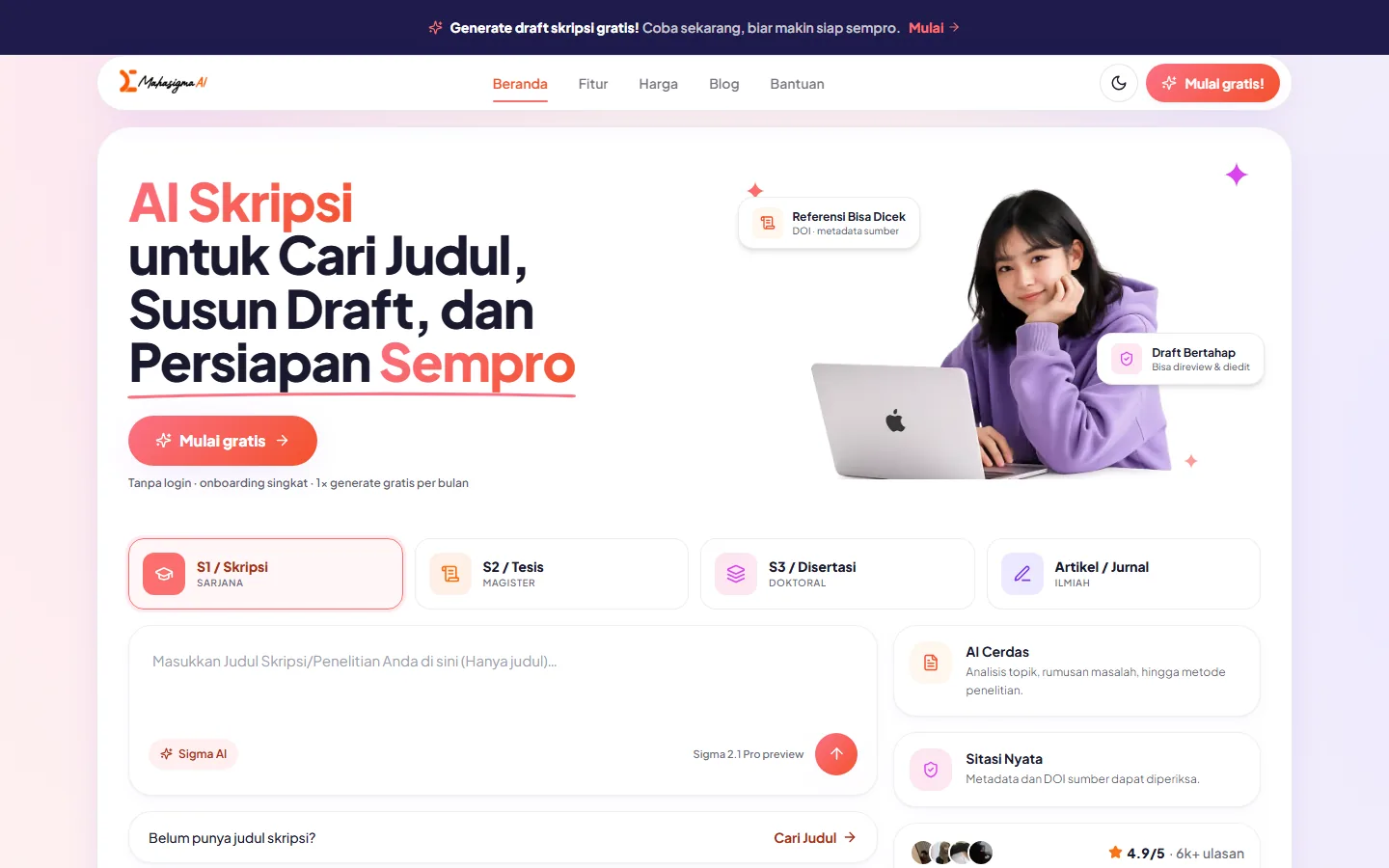
An AI drafting workspace for Indonesian students. It turns a research title into a structured Chapter I–III draft and includes DOI-backed sources the student can open and check.
Challenge
For many thesis students, the hardest moment is facing the first blank page.
A student starting a thesis is asked to produce a title, a defensible background, a problem statement, a literature review and a methodology — in an academic register they have mostly read and rarely written. The work does not stall for lack of effort. It stalls at the point where there is nothing yet to react to.
General-purpose AI answers that badly in a specific way. It writes fluent paragraphs and invents the citations underneath them, which is worse than no help at all when the reader is a supervisor who will check the source.
Mahasigma AI sits in the gap between those two failures: a starting draft that has an academic structure, and references a student can actually open.
- Falls shortA general-purpose chatbotWrites fluent academic prose and invents the citations under it. The failure is invisible until a supervisor opens a source that does not exist.
- Falls shortA thesis template documentIt handles formatting, but the student still has to turn a blank page into an academic argument.
- Falls shortPaying someone to write itFast, expensive, and the student cannot defend a word of it at the sempro.
Bukan cuma chatbot. Sigma AI ngerti struktur, format, dan kaidah akademik.
Research & framing
Structure, flows & trade-offs
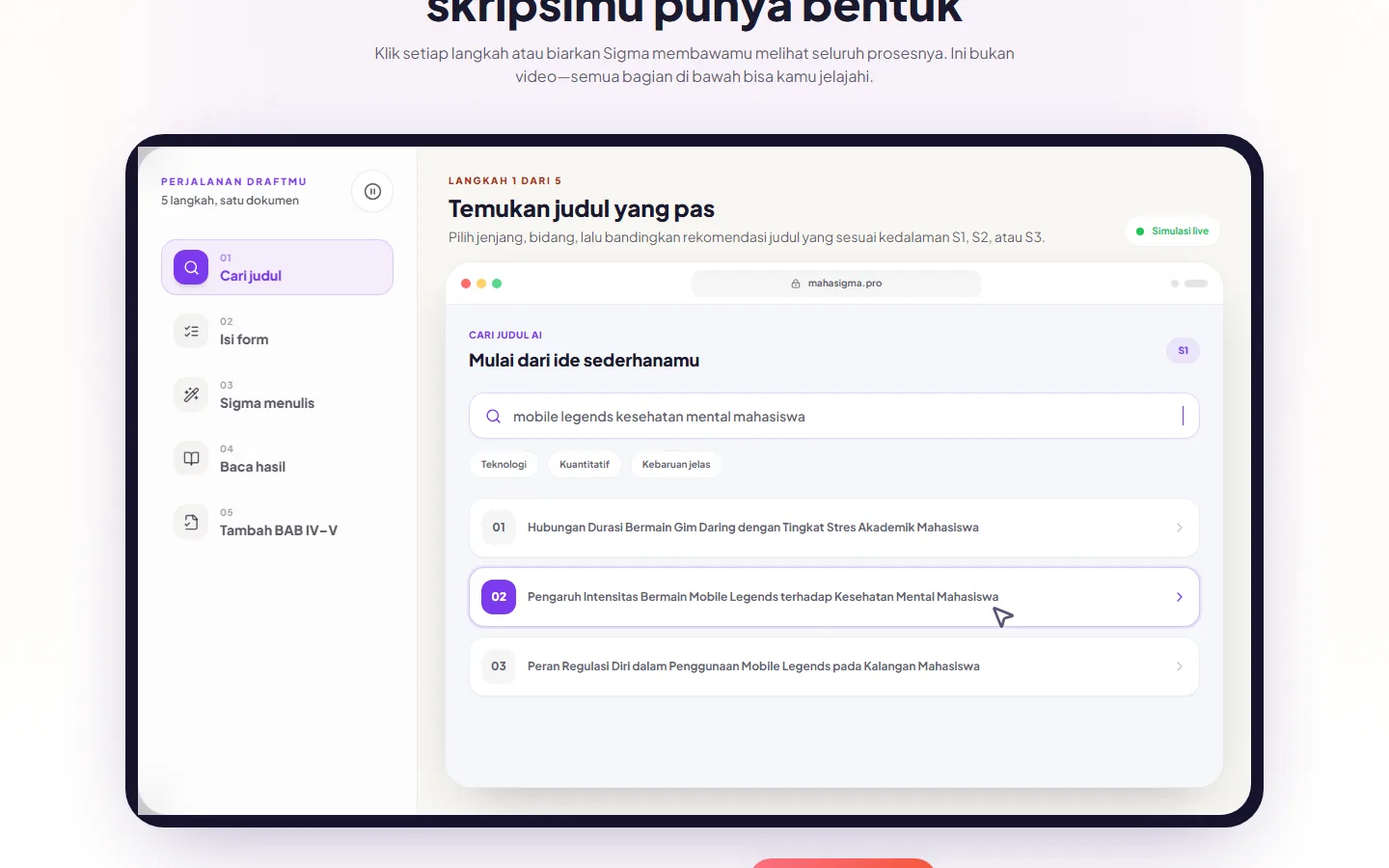
Four steps, in the order the document is actually assembled.
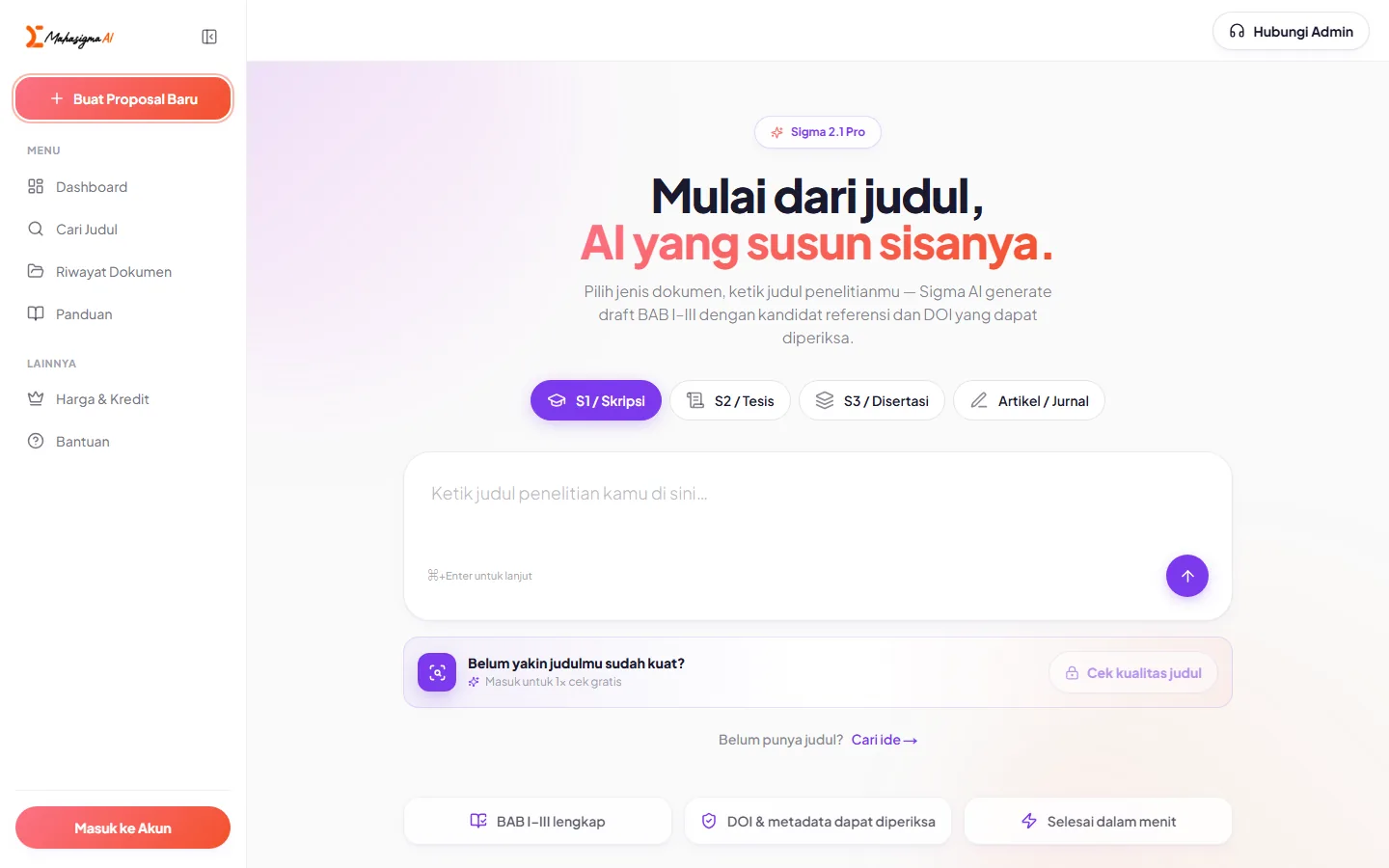
The product is compressed to one stated path — enter a title, complete your details, let the AI draft, review and download — so the scale of what is being attempted stays legible at every point.
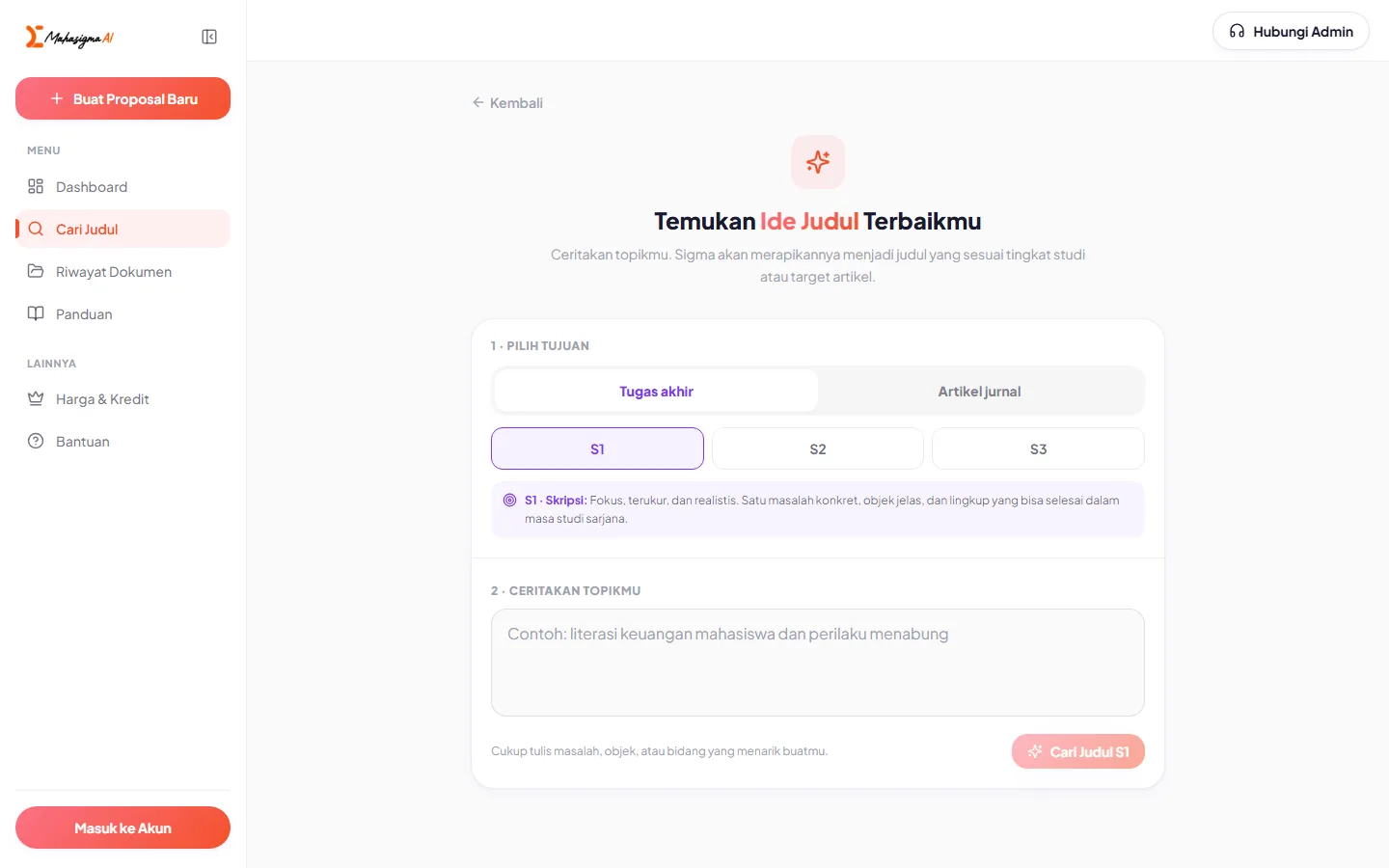
The first choice is the kind of document rather than a feature: undergraduate thesis, master’s thesis, doctoral dissertation, or journal article. Depth expectations differ sharply across those, and asking first is what lets everything after it be specific.
A student without a title yet is not turned away. A separate "find a title" route takes a field and a level and returns candidate titles to compare, which is the real first blocker for a large share of the people arriving.
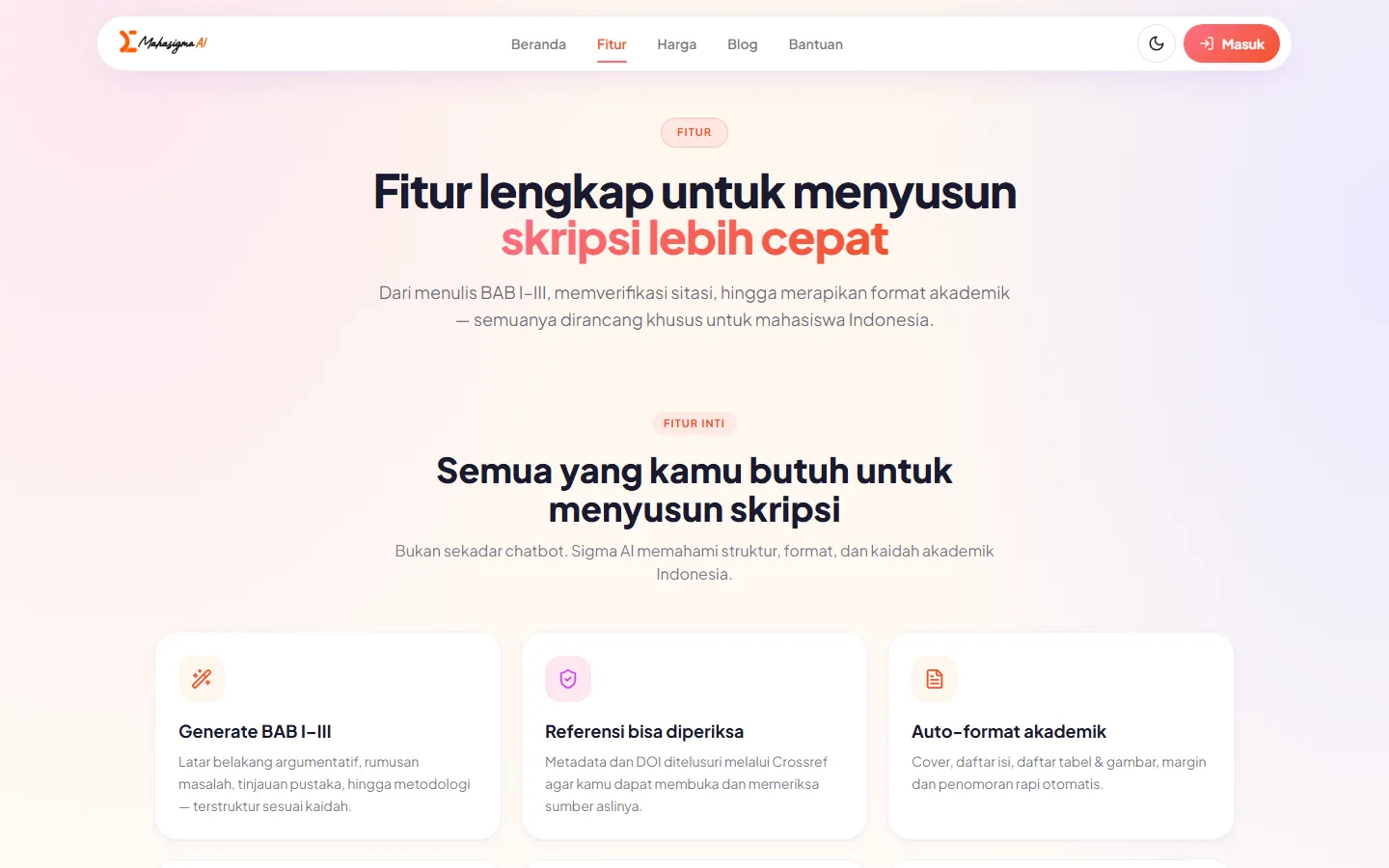
The public site stays deliberately small — home, features, pricing, blog, help — and the homepage lets you walk the product itself rather than watch a video of it. Entry needs no login, onboarding is short, and one generation a month is free, so the first thing a student meets is the tool and not a signup wall.
- ChosenAsk for the document type firstS1, S2, S3 and journal article expect different depth. Asking before anything else is what lets every later screen be specific instead of generic.
- ChosenA separate route for finding a titleStudents who do not yet have a title can reach this task directly, before entering the drafting flow.
- ChosenFree to draft, credits to downloadThe student sees the whole result before paying, which is enough time to understand the product before deciding to pay.
Behind the landing page the product is a workspace, not a chat window. A fixed sidebar carries the dashboard, the title finder, a document history and a guide, with "Buat Proposal Baru" held apart as the primary action — the shape of a tool you return to across weeks, which is how long a thesis actually takes.
Finding a title is a route of its own rather than a mode inside the drafting screen. It asks two things first — whether this is a final project or a journal article, and which degree level — because the depth expected of an S1 title and an S3 title are different questions, and answering them up front is what lets the suggestions be specific.
Solution
A structured draft, sources that can be checked, and smaller revisions that do not restart the whole document.
Chapter I–III generation. An argued background, problem statement, literature review and methodology, produced as a structured document rather than as chat output.
References that can be checked. DOI metadata is traced through Crossref so every source can be opened and its relevance judged by the student — the direct answer to the fabricated citation problem.
Automatic academic formatting. Cover, table of contents, lists of tables and figures, margins and pagination: the mechanical work that consumes a disproportionate share of a student’s time.
Academic settings as first-class controls. Method, citation style, number of references, abstract language and target length are set by the student rather than guessed.
Granular revision. The copilot edits per paragraph — improve this, add theory here, change the method — so a small correction does not cost the whole document.
Export for review. DOCX and PDF out, framed explicitly as a draft to be adjusted against campus guidelines and a supervisor’s direction. The product states its own limit in its FAQ: it is a drafting aid, and the output has to be verified and developed by the student.
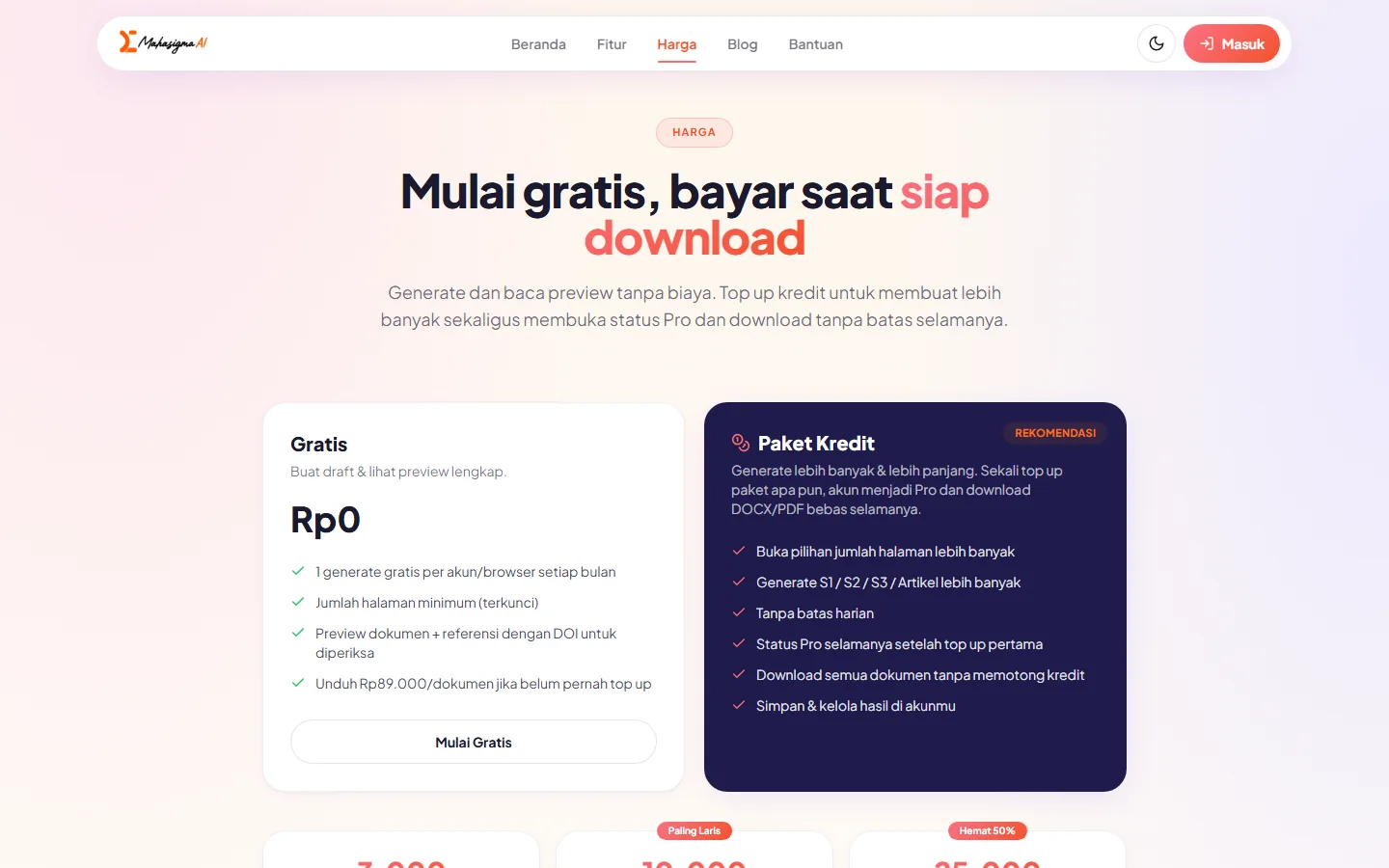
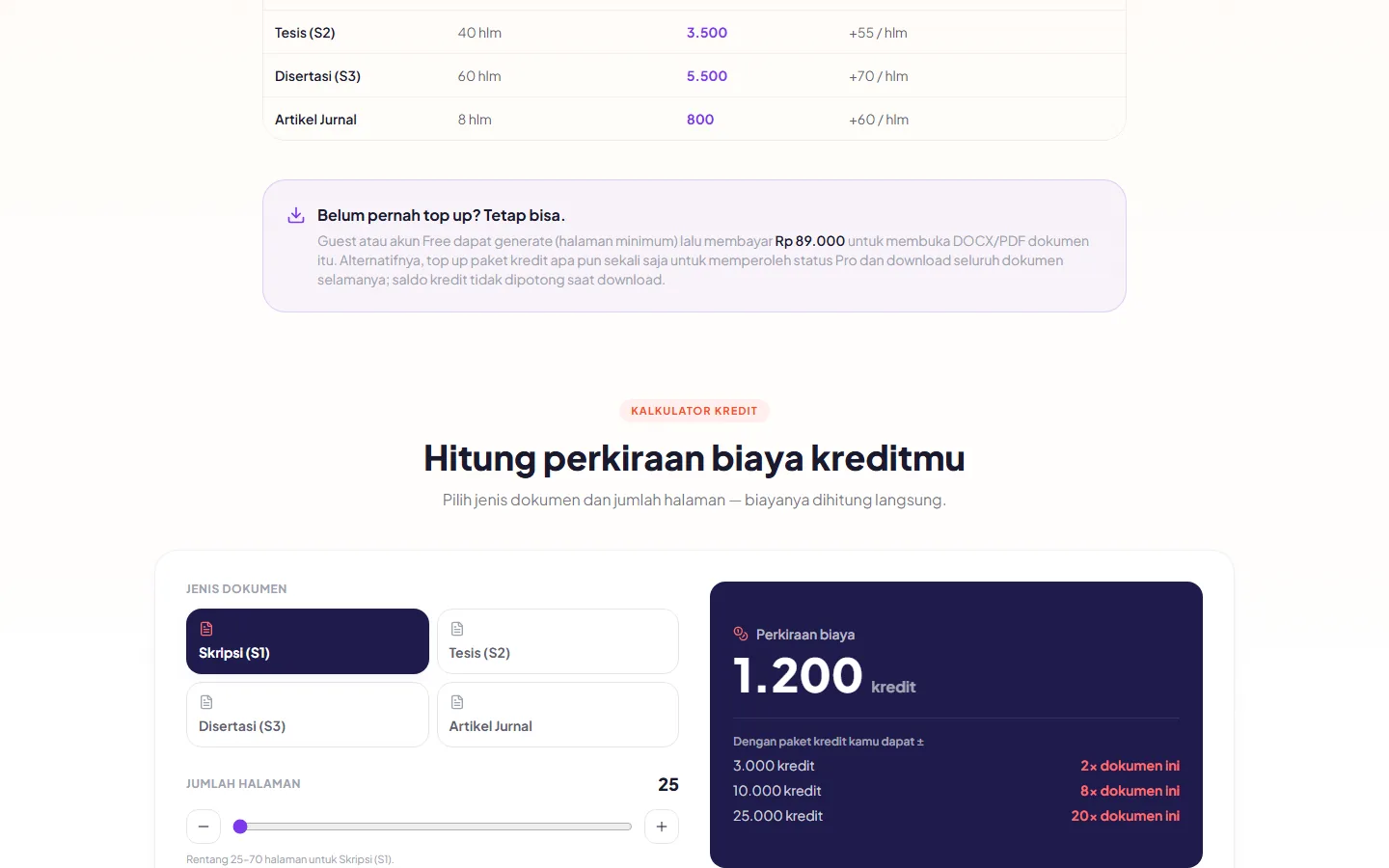
Cost is made legible before anything is spent. A calculator takes the document type and a page count and returns the credit cost — 1,200 credits for a given thesis — against a published per-document rate, so the price of a decision is known at the point the decision is made rather than at checkout.
The free tier is drafting and preview; credits buy the download. That split matters: a student can go the whole way through the work and see the result before paying for anything, which is the opposite of asking for a card before the product has shown what it does.
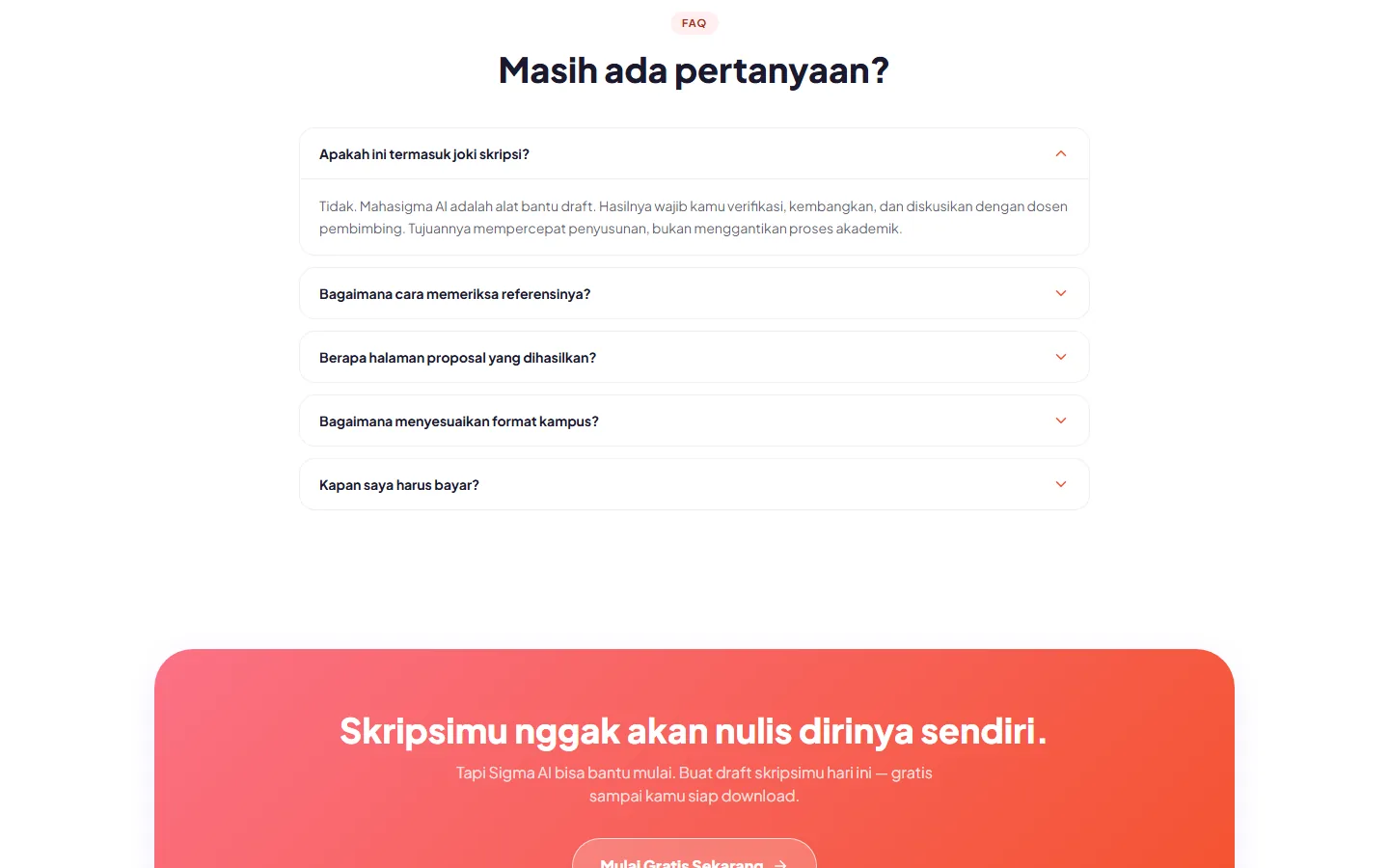
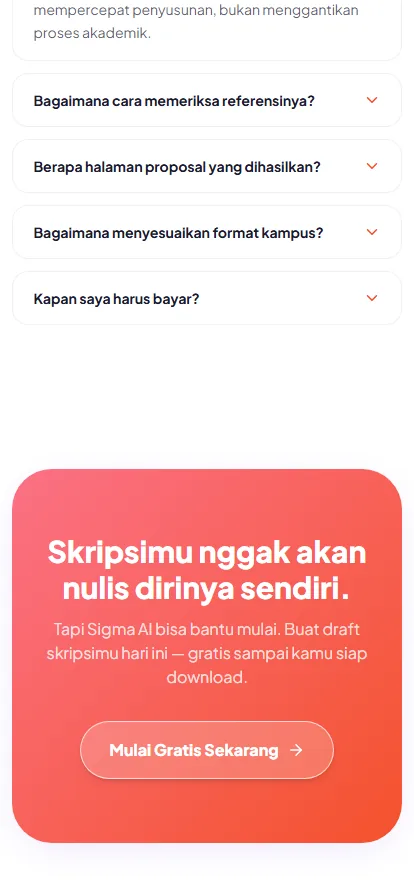
The FAQ is where the product states its own limit, and that clarity is part of the product design. This is a drafting aid, the output must be verified, developed and discussed with a supervisor, and the aim is to speed up writing rather than to replace the academic process. A tool that can produce a plausible thesis chapter has an obligation to say that plainly, in the place people go when they are worried about exactly that.
Validation & iteration
- 01
- 02
- 03
Outcome
- Live at mahasigma.prochecked 1 September 2026
- Title finder, drafting, features, pricing and help all reachable without an accountchecked 1 September 2026
- Desktop and phone layouts both shippedboth captured for this case study
What is on the public internet today: a landing page, a title finder, a drafting workspace, a features page, a pricing page with a working credit estimator, and a help section. Entry needs no login and one generation a month is free, so all of it can be checked by anyone reading this.
What is not claimed here: how many students use it, how many documents it has produced, or how those documents fared. Those are the numbers a case study is usually padded with, and none of them is verifiable from outside the product.
Reflection & limits
The honest limit is the one the product states about itself: the output is a draft, and it has to be verified, developed and defended by the student. Everything in the interface is arranged to keep that true — checkable DOI metadata, paragraph-level revision, export for review rather than export as final — but interface arrangement is a weak instrument against a student in a hurry.
The next thing worth building is not another generation feature. It is evidence that the draft was engaged with: a record of what was checked, what was rewritten, and what the supervisor asked for.
Mahasigma AI adalah alat bantu draft. Hasilnya wajib kamu verifikasi, kembangkan, dan diskusikan dengan dosen pembimbing.