Resume Academy
A CV builder for Indonesian jobseekers with an ATS check built into the editor, so people can improve their CV while they write it.
Challenge
A CV has to work for the screening system before it reaches a recruiter.
A CV submitted online is usually parsed by an applicant tracking system before a person sees it. That opens a gap the jobseeker cannot see across: the document that looks best is not necessarily the one that survives parsing, and an ordinary editor gives no signal either way.
The second gap is skill. Layout, hierarchy, spacing and type are design work, and requiring someone to be good at design before they can apply for a job is a tax on the wrong thing.
Resume Academy is aimed at that gap — jobseekers applying to both Indonesian and multinational employers who need a document that parses cleanly and reads well, without having to learn either discipline first.
- Falls shortA word processor templateProduces a document that looks fine and may not parse. Nothing in it can tell you which one you have written.
- Falls shortA design toolIt can produce a polished layout, but the first reader may be a parser that cares more about structure.
- Falls shortA separate ATS checking siteUpload, wait, read a score, go back and edit somewhere else. The loop is long enough that most people run it once.
Bukan sekadar editor teks. Resume Academy adalah asisten karir lengkap yang membantumu dari menulis hingga melamar.
Research & framing
Structure, flows & trade-offs
Form, preview and score held side by side, so none of them is a separate step.
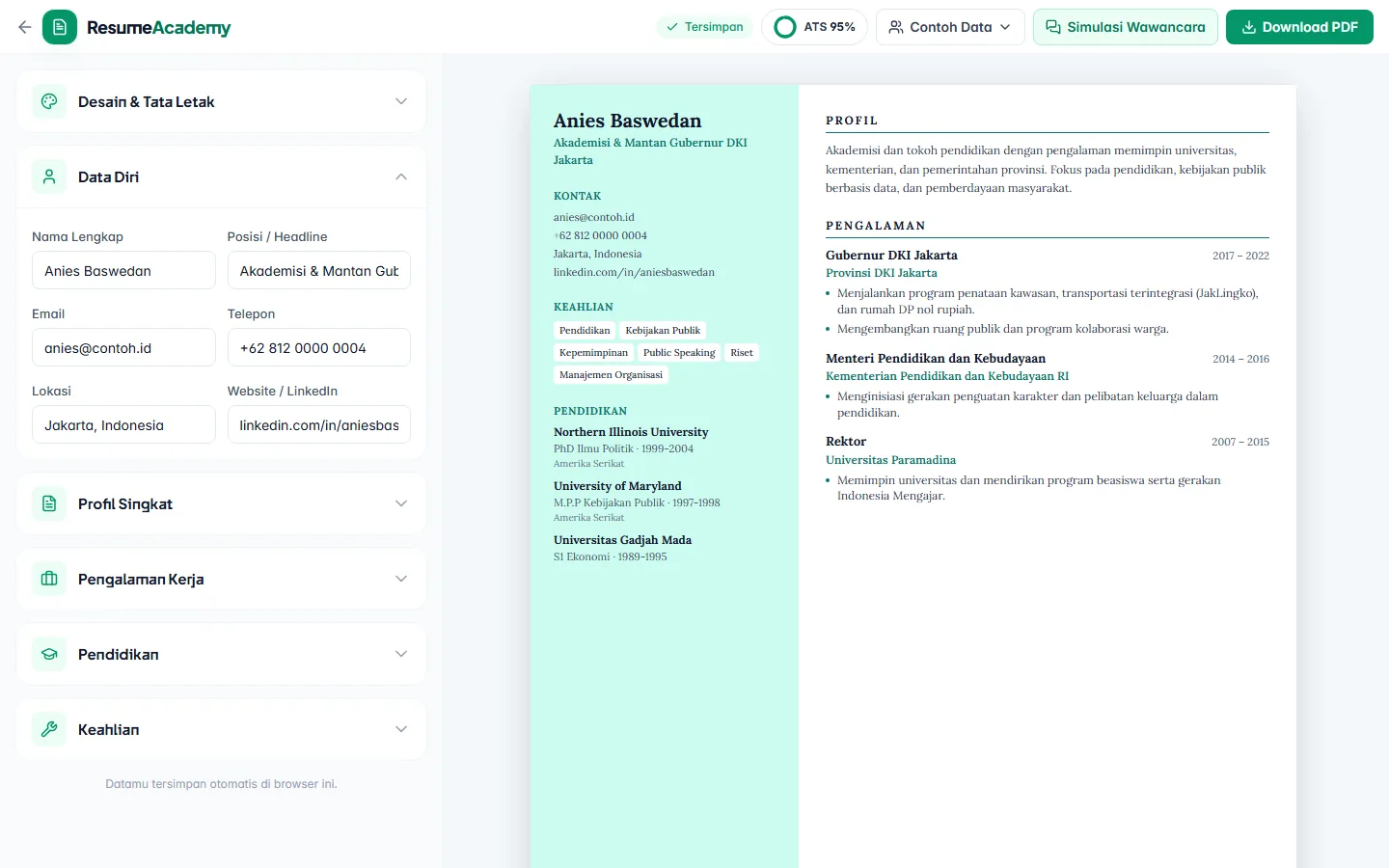
The editor is one working surface rather than a wizard. The form sits on the left, the rendered CV on the right, and the ATS score reads from the same data as it is typed — there is no submit-and-wait between writing a line and learning whether it lands.
Onboarding is compressed to four steps: choose a template, fill in your details with guidance, improve it with AI, download and apply. Templates stay switchable at any point without losing data, which stops the first choice from becoming a commitment made before the person knows anything.
The public site splits into how it works, features, blog, pricing and help. The product itself reaches past the document — a cover letter generator, a bilingual mode, an application tracker and shareable CV links — because the jobseeker’s problem does not end at the PDF.
- ChosenForm, preview and ATS score on one screenThe score reads from the same data as it is typed, so there is immediate feedback while the person is still writing.
- ChosenTemplates switchable at any pointThe person can change templates without losing data, so an early choice does not become a permanent commitment.
- ChosenA deliberately small template setFour families keep the first decision manageable for someone who may not have a design background.
The editor is the product, and it is built as one screen. A sectioned form runs down the left — details, profile, experience, education, skills — with the rendered CV beside it and a toolbar across the top carrying the things you would otherwise have to go looking for: the live ATS score, a sample-data toggle for seeing the layout populated, an interview simulator, and the download.
Nothing there is a separate step. The score is not a report you request, the preview is not a modal you open, and the template is not a decision you are locked into — which is what makes it possible to write, check and correct in one pass instead of three.
Solution
Feedback appears while the CV is still being written.
Real-time preview. Every keystroke re-renders the document, and the preview is the download — what you see is the file, not an approximation of it.
ATS score checker. The CV is scored against a target vacancy from 0 to 100 with specific suggested fixes attached, which makes the feedback actionable rather than a grade.
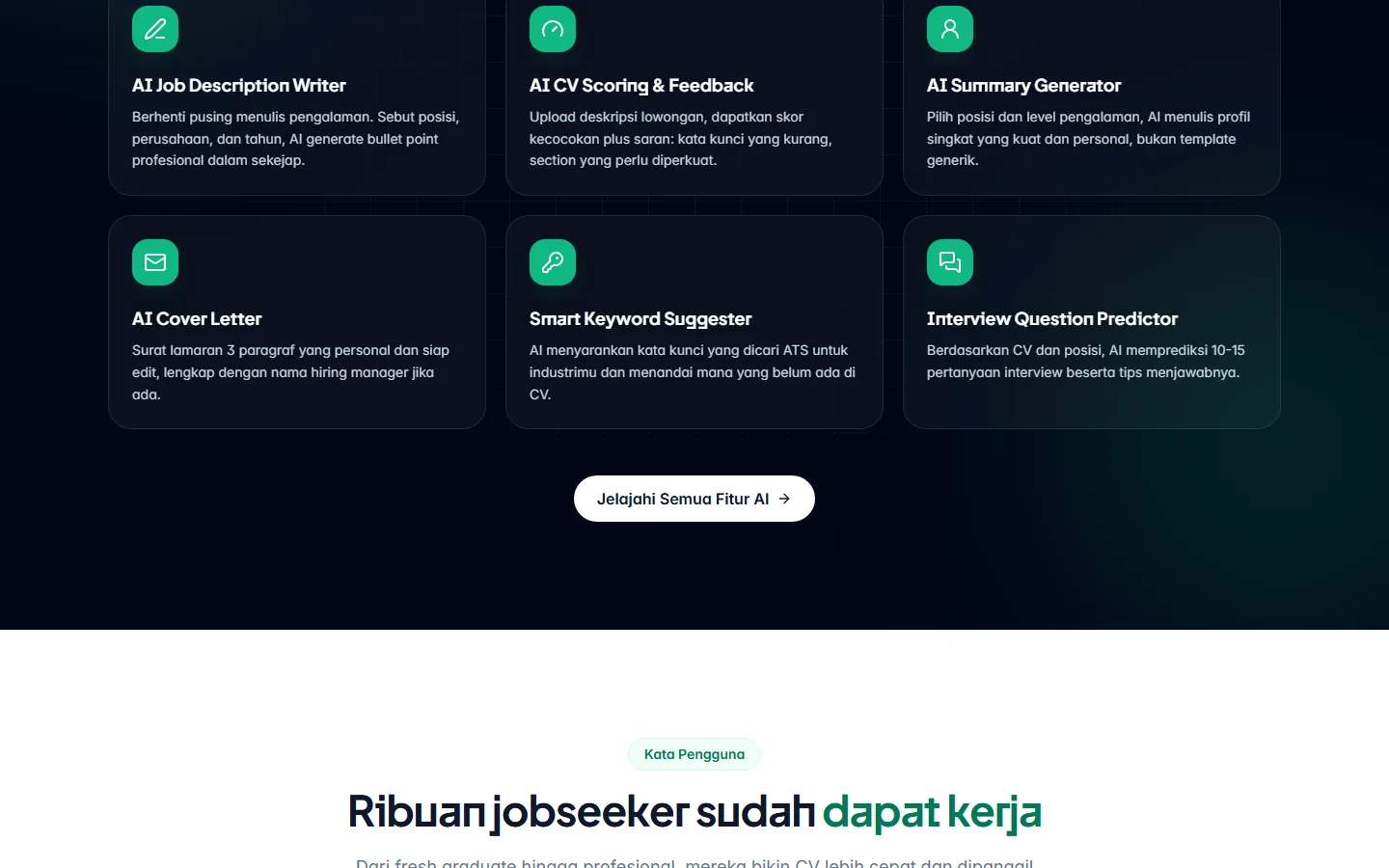
AI writer. Given a role and a company it drafts three to five bullet points that stay fully editable — a way past the blank field, not a replacement for the person’s own account of their work.
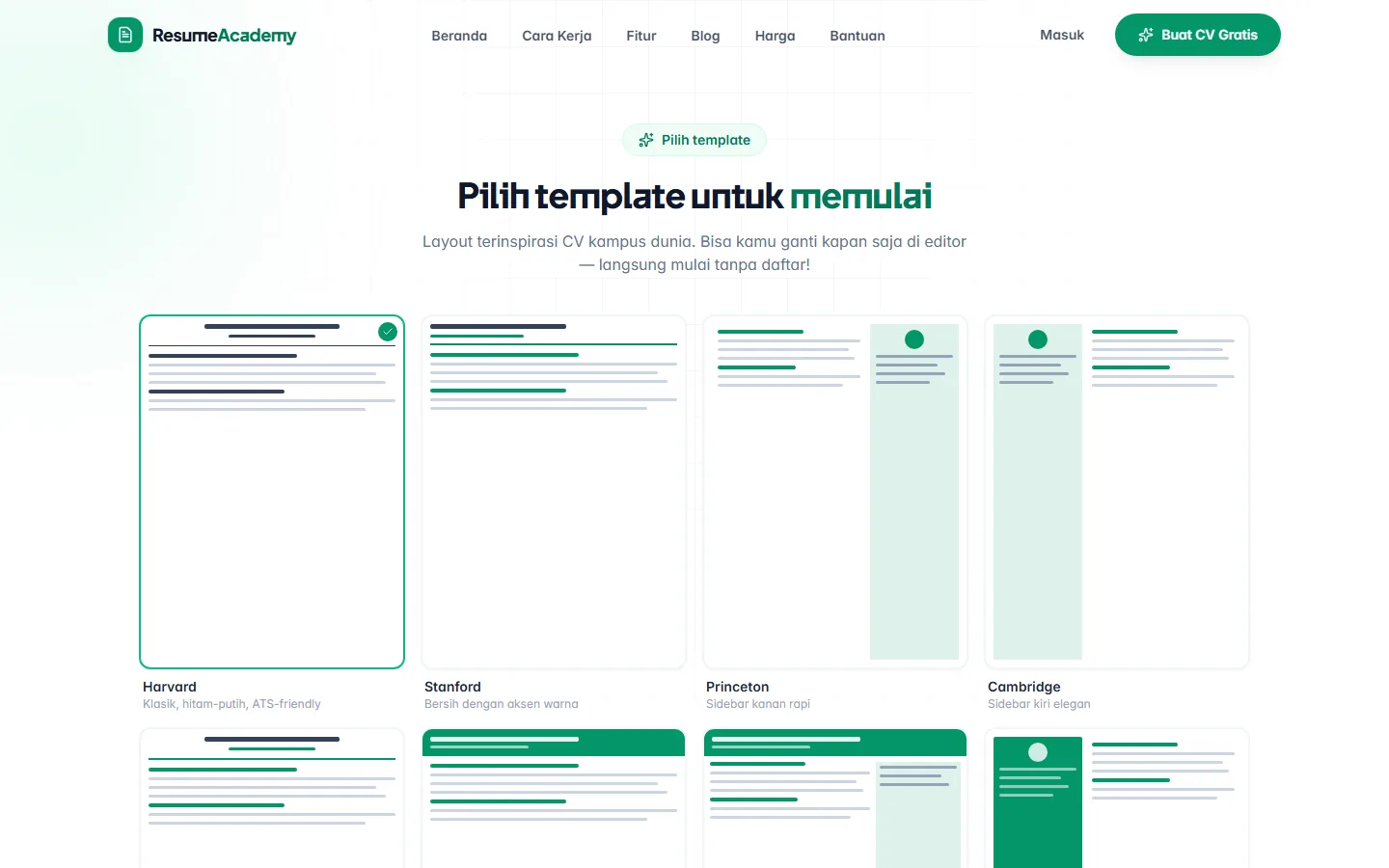
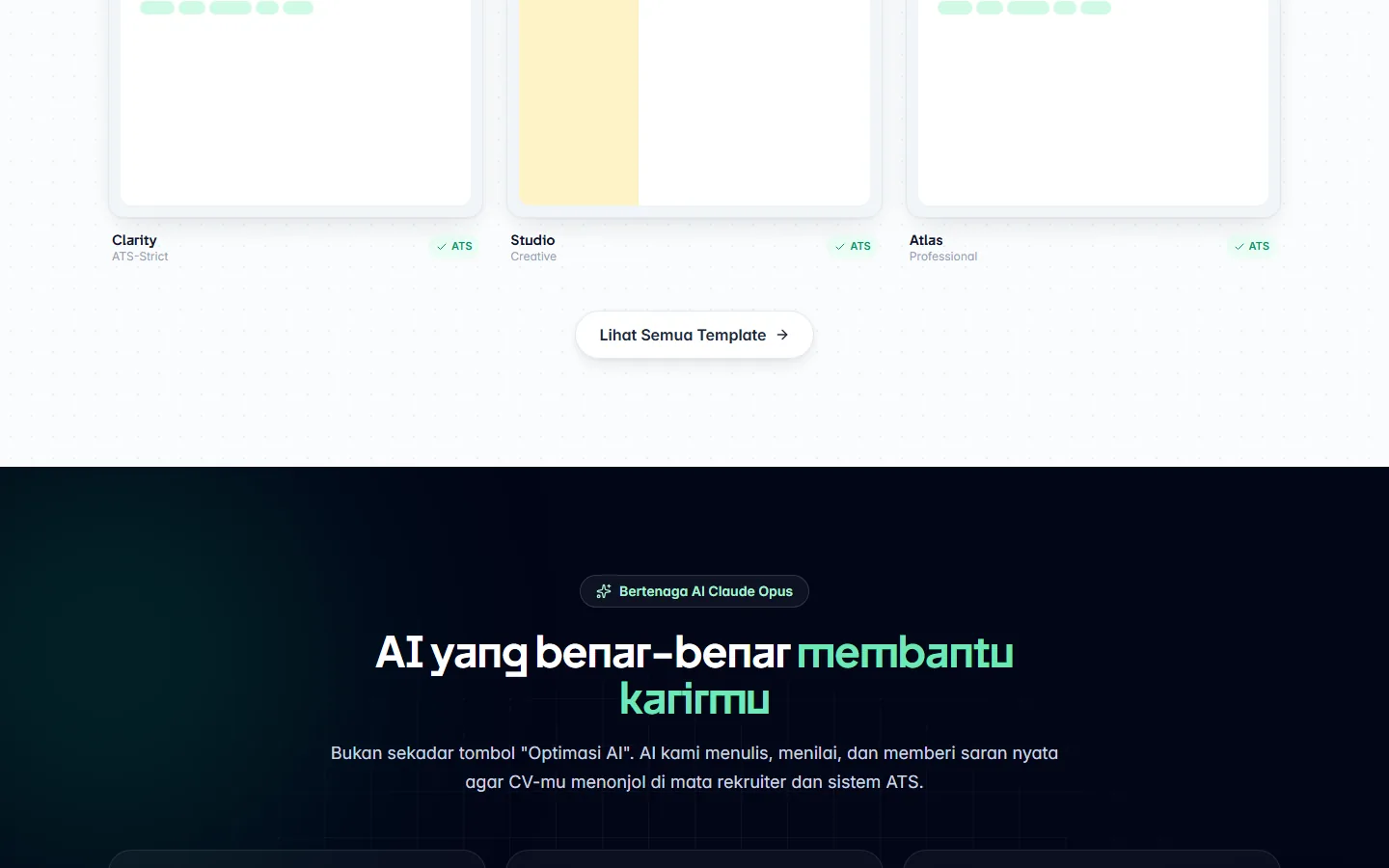
A small template set. Minimal, Corporate, Creative and ATS-Strict, each with colour and font options. The restraint is the point: more choice at this step is a cost, not a feature.
The rest of the application. A cover letter built from a company and a role, an Indonesian/English mode for local and multinational employers, an application tracker carrying Applied, Interview, Offer and Rejected states, and a shareable CV link with password protection and open analytics.
Templates are named after universities — Harvard, Stanford, Princeton, Cambridge — and each is labelled with what it suits. That is a more useful handle than "Template 4": it gives someone with no design vocabulary a way to reason about the choice, and the ATS-checked marker on each one keeps the aesthetic decision from quietly becoming a parsing risk.
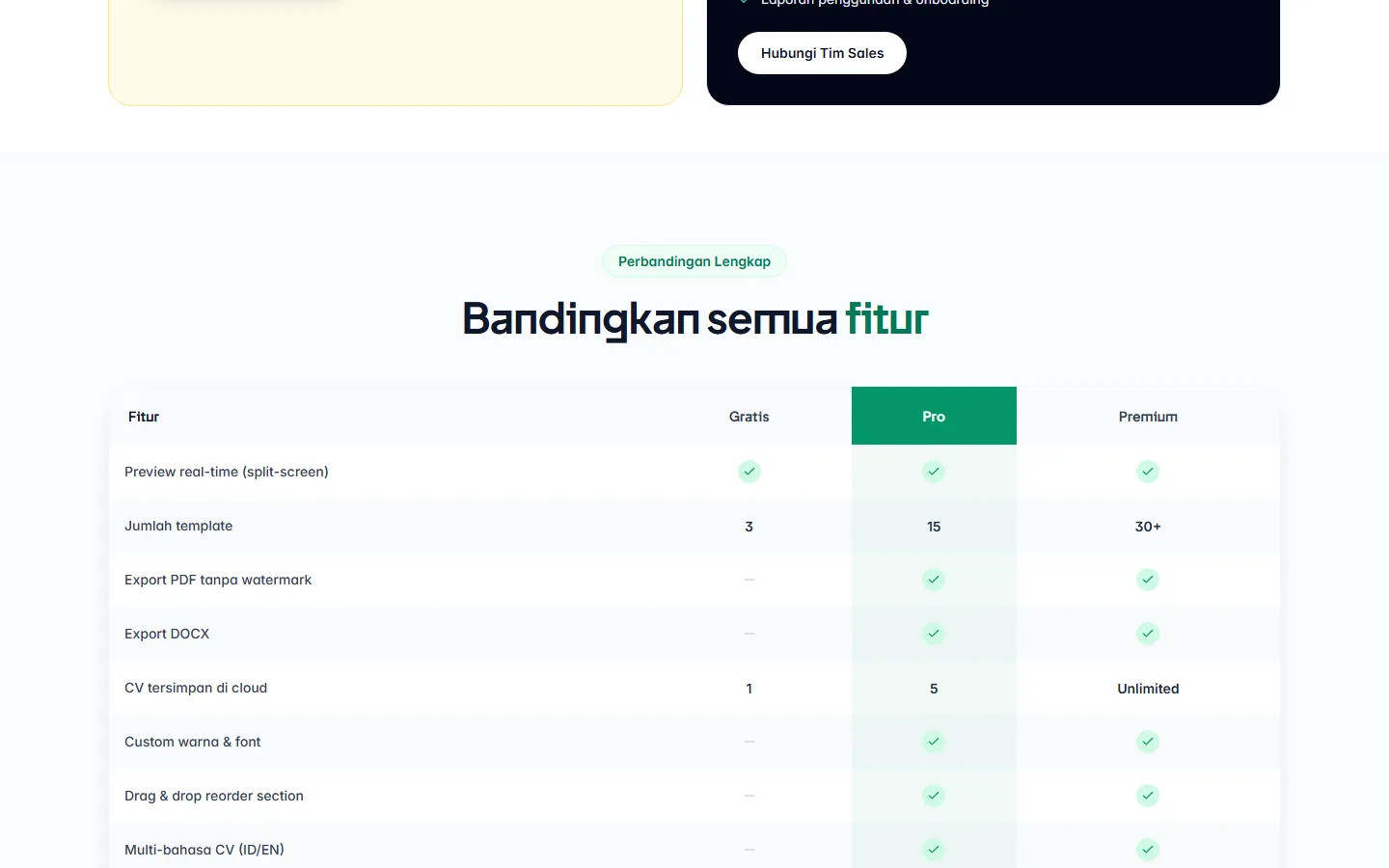
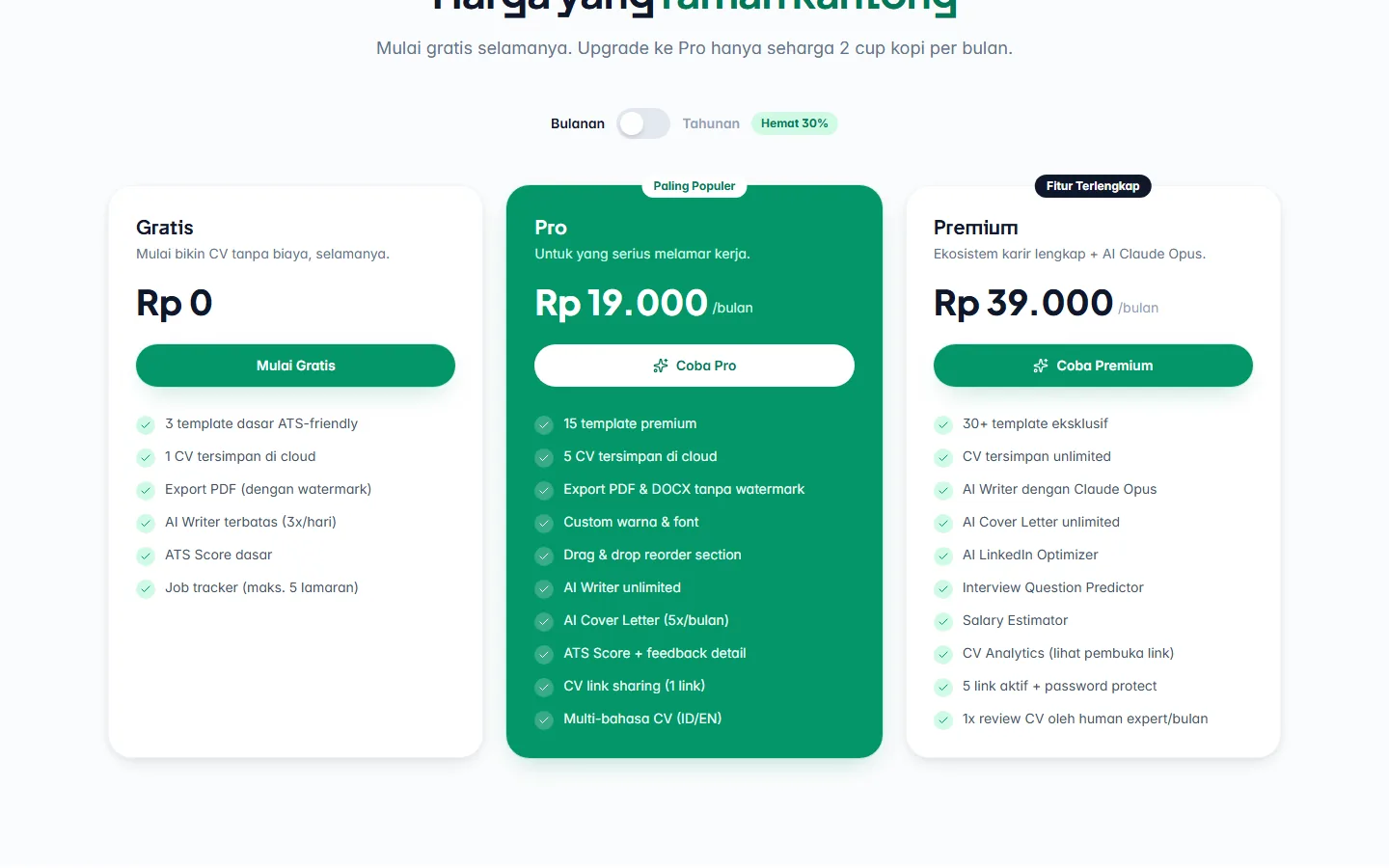
Where the tiers differ, a full comparison table says so line by line: preview, template count, watermark-free export, DOCX, cloud storage, custom colours. Putting the limits in a table rather than in the small print is the honest version of a pricing page.
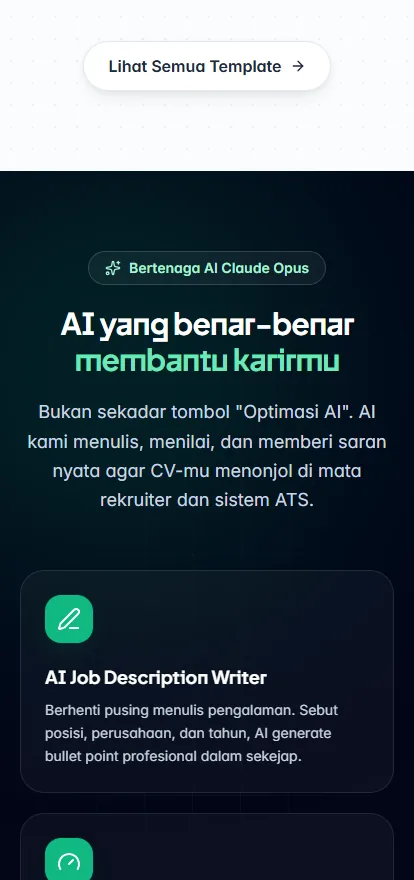
The product continues beyond the document. A cover letter generator, a bilingual mode, an application tracker and a shareable CV link with password protection and open analytics all sit inside the same account. Together they support the larger goal of reaching an interview.
Validation & iteration
- 01
- 02
- 03
Outcome
- Live at resumeacademy.netlify.appchecked 1 September 2026
- Editor, CV builder, features, pricing, blog and help all reachable without an accountchecked 1 September 2026
- Desktop and phone layouts both shippedboth captured for this case study
The editor itself is public: the form, the live preview, the ATS score and the download are all reachable without signing in, which is unusual for a product of this kind and is the strongest thing it does. A reader of this case study can open it and check every claim above in about a minute.
The tiers, the template count and the export limits are published in a comparison table rather than discovered at the download button.
Reflection & limits
The ATS score is the product’s central promise and also its least inspectable part. It returns a number and specific suggestions, but not the rule that produced them, so a user who disagrees with a suggestion has no way to argue with it.
The interesting next version is not a better score. It is a score that shows its working — which keyword, in which line, measured against which posting — because a jobseeker learns more from one explained rejection than from ten unexplained percentages.